The lamps are going out all over America

The author poses in front of the White House, giving the thumbs up.

Leaving the US felt like the last chopper out of Saigon, except it was the Americans being left behind, and instead of a Huey it was an Aer Lingus A321neo.1

I spent about two and a half weeks in the US in July and August, for a mixture of business and leisure. If you follow me on social media or tried to visit this blog at some point in the past few weeks, you might have noticed my entire online presence disappearing temporarily. This was no accident. I was trying to make sure I made it through the US immigration process unscathed, having read a few too many news stories about travellers being refused entry and/or detained in recent months, such as the journalist who had written about Palestine protests, the academic whose phone contained messages critical of Trump’s government, or the tourist who had saved a meme of JD Vance. By those measures, it is not difficult to imagine myself being refused entry2 based on any number of features of my online presence and body of published writing. And so I temporarily self censored: I scrubbed my online life, I factory-reset my phone (after backing it up, obviously); I brought my work laptop and left my personal one at home; I left my keffiyeh and anything covered in provocative stickers in Berlin; I was even careful about what books to pack for the plane ride.3

As it happened, the process was almost comically smooth. They didn’t even open my bag; there was some process by which travellers were selected to undergo a second round of security screening, but I could not discern what it was and was, in any case, not among them. All that happened was a bored-looking agent fingerprinted me and took my photo, then asked where I was going, why, and for how long, before ushering me onwards. It was over in less than three minutes.

I had suspected this might happen. I wagered there was a small chance I would run into actual difficulty, possibly being refused entry, and a large chance that it would all be fine and my preparations would look like paranoia in retrospect.4 Talking to friends and family about the issue before and after, they generally occupied one of these two positions too: some seemed positively doubtful that I would be admitted and/or very seriously advised me to “be careful” during my visit; others seemed surprised that I was worried at all.

This is, I think, characteristic of the US’s descent into authoritarianism.5 Immigration agents are not rejecting or abusing all visitors, but they are encouraged and empowered to do so whenever the fancy strikes them. Equally, not every Hispanic person in the US is being imprisoned, but federal agents have made it clear they may imprison anyone who is (or looks) Hispanic, if they feel like it. So on and so forth. Much of what is happening obviously contravenes US federal and constitutional law, so rather than being applied as uniform policy, it falls back on that wonderfully opaque tool: officers’ “discretion”. In any case, the mere possibility that you’ll be unlucky is enough to create fear and thereby limit people’s freedom of action and movement; thus, the regime is exerting power and achieving some of its aims even when you’re not actually being detained. My self-censorship is a prime example.

My aim here is not to write a comprehensive account of The Current Moment in America, though. There are many people much better suited to the task. I’d recommend Jack Hill’s excellent piece in the Philadelphia Inquirer or Charlotte Shane’s essay, for example.


The United States of America and I have always had a complicated relationship. Much about the country and its culture appeal to me, embarrassingly. I am of course an avid baseball fan. I went to an American university for my Master’s, even if I did the whole thing at a European satellite campus. And – at the risk of endangering my leftist credentials – I am genuinely compelled by the professed ideals of the US as a political project, their implementation notwithstanding. “We hold these truths to be self-evident, that all men are created equal” is among the most powerful sentences ever written, both in terms of influence and pure prose.

But it’s always begun and ended at profession, of course. The history of the US is one of cognitive dissonance, of lies, of broken promises. If we wish to talk about founding documents, it can never be claimed that the US was actually founded on principles of liberty when its constitution still contains the text defining Black people as three-fifths of a white person, and when the man who wrote “We hold these truths” was a prolific owner of enslaved people. The whole concept of the nation as a “melting pot” of immigrants, bound together only by ideals – compelling as that might be in abstract – is inextricably bound to its foundation on land “cleared” of its indigenous inhabitants by means of genocide. None of that can be put aside; it is written into America’s DNA.

I thus find myself torn. The largest part of me thinks that the idea of America is irredeemable, that the soul of a country so stained with the blood of hundreds of millions can never be saved. And yet I can’t help but be attracted by the notion – an old one at this point – that even if the United States has never upheld its own ideals, those ideals are sufficiently powerful that it is worth trying to radically remake the country so that it does. The history of America is one of promises made dishonestly and then broken: but imagine if they were fulfilled.

So I am compelled by Martin Luther King Jr.’s hope that “one day this nation will rise up and live out the true meaning of its creed”. I am moved by the text of Abraham Lincoln’s second inaugural address.6 I became emotional looking at the memorial to the 54th Massachusetts Infantry, one of the first Black regiments of the US Civil War, in the National Gallery of Art; I was thinking about what it meant to those men to know that if there was going to be a price in blood for the abolition of slavery, they were putting their share on the table. It was a crusade, a true holy war.  Scarcely in history has there been a cause so pure or so righteous as that of freeing people from bondage. I don’t know what proportion of those (especially freedmen) who fought were purely concerned with abolition, and were ambivalent or even negative about the US as an idea, but if any thought they might in the process build a country worth living in, who am I to say that dream was foolish?

The National Museum of African American History and Culture in D.C. is excellent.7 I read much of its history section as a struggle between those two ideas: that the US has an evil at its core that can never be expunged; and that even if those who founded the US never believed in the principles they committed to paper, those principles could upend the world if made reality. Both of those positions seem more than defensible to me. It isn’t my call. It isn’t my country. I was not born there, I do not live there, and I am not most hurt by the privations it inflicts.

What does all that mean now? A lot, in fact. I promised I wasn’t going to try to articulate a grand narrative of the current moment, but I am hardly the first to note that what the US is currently experiencing is merely the most recent stage of the 150-year backlash to Reconstruction. When you read accounts of that time – what the Radical Republicans wanted to accomplish, the volume of  new Black representatives elected, state power being used as a force for good (i.e. by sending the US Army against the KKK), you feel like you’re being given a glimpse into an alternate universe in which everything worked out –  one where the arc of history really does bend towards justice. If there was an inflection point in the battle for America’s soul, it was the Compromise of 1877.

More recently, I have long been of the opinion that the Republican Party’s transformation8 can be read as a reaction to 2008; there are so many American conservatives who are simply unable to forgive the rest of the country for making a Black man president.9 What we are witnessing is a section of the population fundamentally unable to accept the slow march of social progress. When they say they hate “DEI”, they mean that they think racial minorities (and women, and openly LGBTQ+ people) occupying prominent positions in society is fundamentally and inherently unnatural.10 On a strategic level, their political project doesn’t have real policy goals: they just want to turn back time. Again, I am not making any novel observations here.


The morning I left for the US, I downloaded Christopher Isherwood’s The Berlin Stories to my e-reader. I have been meaning to read them for some time. This pair of autofiction books were the basis for the musical Cabaret; Isherwood was a British writer who lived in Berlin from 1929 to 1933, leaving not long after the Reichstag Fire Decree. The novels are about many things, but their stories fundamentally concern being a late-20s expatriate against the backdrop of a country rapidly disintegrating as fascism rose. I live in Berlin and was travelling to the United States at a time when a far-right authoritarian regime is consolidating power. I am just a few months younger than Isherwood was when he finally left Germany. It felt apt, and I’d been meaning to read them for a while anyway.

Though I had actual reasons to travel Stateside, I was admittedly also motivated by a kind of scholarly curiosity. While my academic work doesn’t focus on the far-right, I have long been interested in it as an object of study.11 So having followed events in America over the past few months with significant interest and concern, I was very curious to see them up close. When I first read about Isherwood,12 it did occur to me how interesting his experience must have been, all the tragedy notwithstanding.

What America is going through in this moment is not unique in the world;13 but then neither was Germany in the 30s. If I’m being honest, much of my preoccupation with the American experience now is to do with my personal connections with the United States and the obvious influence of its culture globally – particularly for anglophones. Still, I think we all recognise that America’s trajectory is important not just for its own sake but because of how it affects the rest of the world. Again, the Germany parallel is instructive. Even at the time, people in other countries were more interested in the rise of Nazism than they were in the rise of Italian fascism, the Iron Guard in Romania, or other fascist and fascist-adjacent regimes, because it was evident to many observers that 1. the German regime was intent on transforming not just Germany but the world, and 2. that they had, (unlike, say, the Italians) the means to do so.

They were proven right. The Berlin Stories was first published as an omnibus in 1945. The political events that form the stories’ backdrop are ominous precisely because we know where they led. I don’t know that now. I do know that very soon after I left D.C., Trump seized control of the city and deployed the national guard and paramilitary federal law enforcement to its streets (which I vote we start calling Martial Law Lite™).14 I also know the regime has stated its intention to effectively purge the Smithsonian Institutions of material it dislikes, so those exhibits that so moved me may not be long for this world. But I do not know how this ends, or at what stage of the process we are at, or anything.

I felt at my most Isherwoodian (if I can coin a word) on my last night in D.C. We went out to a few bars, and ultimately ended up at a kind of speakeasy/dance club behind a door at the back of a deli. I was beginning to feel tired (on my fourth night out in a row) and I had a flight to Albuquerque early the next morning, so I was less than totally into it. As I looked around, I realised everyone else in that room seemed to be really into it though, and I was suddenly overwhelmed by how beautiful and precious a moment it was. Even with everything outside already so bad and getting worse, everyone here was having the time of their lives – not because they were ignorant of or avoiding the reality of the moment, but because when everything is going to shit, joy is more necessary than ever. I wanted to seize each person by the face and tell them I loved them, that they deserved this, that I’d buy them a drink. I didn’t, of course. It would’ve been as self-defeating as it was insane: it was a special moment because it was carefree, and to point it out would be to ruin it.15

Like I said, I don’t know how all this ends. However, I think even in the better scenarios – where this tide of right-wing authoritarianism in the US and across the world is reversed in the relatively near future – things are going to get worse before they get better. So while I think we have a duty not to despair and not to let ourselves or those around us give up hope, I am also scared. I’m scared for all the people who are going to get hurt; I am scared for the people I care about who are in harm’s way; I am scared for the people who were getting hurt even back when we considered things “normal”, who still are now.

However, while I am particularly given to draw historical parallels right now because I’m currently working on a literature review that requires me to read nothing but material about the lead-up to major historical catastrophes16 (and because of who I am as a person), those comparisons shouldn’t be read as predictive. The fact that this moment felt to me like being in Berlin in 1932 does not mean that the Berlin of 1945 is an inevitability. The comparisons can also be instructive. If you know anything about the Nazis’ seizure of power and the lead-up to WWII, you know how much might have been done (by all kinds of people) to prevent what happened, whether before or after ’33.

So, if there’s a lesson to take away, it’s that. Things look really bad: what do we wish had been done before, when things were about to get really bad?


  1. I am aware that a WWI reference in the title, a Vietnam reference in the first line and a WWII metaphor throughout most of the body is messy, and you might consider that bad writing. But consider this: bite me. ↩︎
  2. But not detained: on the insistence of my mother I travelled through Dublin, which has US immigration preclearance. ↩︎
  3. As I read a lot of non-fiction, most of it is either left-wing political theory or about nuclear weapons, and neither of those felt like a good look. ↩︎
  4. Somewhat like Y2K; if you let me, I will go on an extended rant about how the popular memory of Y2K as a nothingburger exists only because countless engineers patched the issue in advance, and we have learned precisely the wrong lesson as a result. ↩︎
  5. it is evident that democracy in the US is being dismantled. You can call it the path towards actual fascism (I think there is ample reason to do so, and the potential consequences are almost unthinkably bad) or not, but if you don’t at least recognise this as a far-right authoritarian regime which is trying to consolidate power, you are either woefully under-informed or suffering from a severe failure of reasoning. Either way I don’t know that reading this will be much use to you. ↩︎
  6. I had already read it several times but inscribed in stone at the Lincoln Memorial it gains new emotive power. I’m only human. ↩︎
  7. You may be gathering that a lot of my time in D.C. was spent in museums. ↩︎
  8. Not to imply it was anything good before 2016 – I have no time for those who are nostalgic for “normal Republicans” like George Bush – but it is worse, and very different. ↩︎
  9. In Chapter 8 of The Kingdom, the Power, and the Glory: American Evangelicals in an Age of Extremism, Tim Alberta quotes (former National Director of Faith Engagement for the Republican National Committee) Chad Connolly as saying, “Obama created the race problem in America”, which sort of sums up the whole thing. There was a previous time when this bloc felt assured that white supremacy in America was unassailable; when they lost that assurance, that to them was the moment there came to be a “race problem”. Regardless of Obama’s merits as a president, his election was symbolic. To US conservatives, it symbolised that loss of certainty – and was to them the ultimate humiliation. ↩︎
  10. Since they think it is fundamentally unnatural, they assume it must be a conspiracy. Society can’t just be changing slowly over time and their ideals going out of fashion: there must be an orchestrated project to indoctrinate people and rig the system. When they attack media and universities, it is partially because they’re trying to find the secret cultural control centre that they genuinely believe must be at the centre of all of this. ↩︎
  11. Longtime fans will remember me reporting from Covid conspiracist rallies in 2020. ↩︎
  12. After a tour of historical queer Berlin a few months back. ↩︎
  13. See also: Russia, the UK, Hungary, El Salvador, Italy to an extent, Poland until recently, South Korea very nearly etc. ↩︎
  14. Charlie Kirk kind of gave the game away when he called for “military occupation” and “tanks” in “every street”, similar to when Kristi Noem said the purpose of the National Guard deployment in L.A. was to “liberate the city from the socialists and the burdensome leadership” of the municipal and state Democratic administrations. To that end, I think it is the wrong approach to point out that they’re making it up when they say D.C. is full of crime; obviously that is true, but it doesn’t matter, because: 1. When these people say “crime” they are referring to the existence of homeless people, or the presence of young Black people; they mean it that way and their supporters understand it that way. So do a lot of people who think of themselves as moderates, who are saying stuff like “but they have a point about the crime”. 2. They’ve explicitly admitted the real aim is to seize power, so anyone arguing the facts of their cover story is wasting their time and letting them make the debate about what they want. Stop trying to debate fascists, for the love of god. They’re establishing a quick-reaction force to crush domestic dissent, this really is not the time to try to have a mature discussion about crime statistics. ↩︎
  15. “There is much pain in the world but not in this room”, to quote the meme. Why bring it in? ↩︎
  16. Which reminds me, if you know any good scholarly work on the theories of war causation that I might not have read yet, please send it my way, because I need to read all of it. ↩︎

Hey, that sounds familiar

Comic by Nedroid. Rearranged into horizontal format by the author.1

An interesting thing happened to me last summer: I was plagiarised.

Basically, a post appeared on a political science blog belonging to a highly-regarded European university which was, apart from about two original paragraphs, a near word-for-word reproduction of an article I had written just a few weeks prior for the blog of the organisation I then worked for. The plagiarised post was published under the name of a real academic, though not someone I had heard of. The theft was laughably blatant: the sentences had been rearranged a little in some places (though not everywhere), and almost nothing had actually been reworded.2 Even the section heading I chose as an homage to Rosa Luxemburg was kept in place.

This was a novel experience for me. My writing has elicited strong positive and negative reactions from various people at various times, I have been the subject of minor far-right smear campaigns,3 and I have even passed my own work off as the work of others,4 but never before has someone wanted to claim that my work was theirs. Fascinating.


I did not discover the theft on my own; a colleague came across the blog post and shared it with the team.5

My first instinct was to be bemused and amused.

Even if I had been otherwise inclined to get angry, the repackaging job was so half-hearted and amateurish as to be comical. It was also, frankly, somewhat flattering to know that even a frankensteined version of my writing was apparently good enough to be published in this setting.

The bemusement had a similar genesis. Though the venue of the plagiarism was not formally academic – not a journal or conference, and certainly not peer reviewed – it was the blog of a university, and the person taking credit was a career academic. Given academia (nominally, theoretically) takes plagiarism very seriously, why risk the reputational damage on such a low-effort endeavour? It’s one thing when academics steal from their own students, when they may reason that no one will ever find the original; it is quite another to steal from something very recently published, which related to a small, specialised field – the practitioners of which number in the low dozens in Europe and all know each other.

So after I’d exhausted the “this is proof that I’ve made it as a writer” jokes, I became fixated on one question: how did this happen?


The seminal work on internet plagiarism was, of course, published 14 months ago by Hbomberguy. The four-hour video essay contains much valuable meditation on the psychology of and motivation behind plagiarism. It was on my mind during this episode. Still, it can be applied to my case only partially, I think. It is concerned chiefly with plagiarism in the realm of YouTube, and Hbomberguy’s thesis for why people plagiarise – because they crave validation and/or success but lack the skills to achieve it, and see those they crib from as unworthy of their respect anyway6 – felt to me like it failed to fully explain my experience.

In the case of plagiarism, as in all harmful behaviour, I am interested in knowing what the offending parties are thinking when they do it and how they justify their actions to themselves.

I find it very hard to imagine the process of copying and pasting someone else’s writing into your Word document7 and then trying to conceal it by way of editing. Even if you don’t view that behaviour as wrong, would you not be kind of embarrassed to debase yourself like that? Perhaps, as someone who really enjoys writing in almost any context, I am overestimating the pride people have in their own work, or underestimating their laziness. Perhaps I am imagining that people’s consciences are more vocal than they really are.

Still, we’re not talking about an undergrad ripping off an obscure journal article to finish an imminently-due assignment for a class they don’t care about, this is a case of someone who chose a career in academia publicly taking credit for someone else’s work.8

I don’t know about anyone else, but I have no interest in receiving credit or praise as such; I am interested only in receiving credit or praise for my work. Yes, I absolutely crave external validation – I’m only human – but only actual validation of me as a person, not the mere performance of it. I will feel validated only if the thing people are commenting on is actually the product of my labour and intellect and therefore a reflection of my abilities and character. I don’t just want to hear the words.

Also, does it not eat at you? With every positive comment, every time someone makes reference to what “you” wrote, do you not feel a twinge in your gut? Maybe it’s my deeply-rooted cultural Catholicism speaking, but I think that would bother me. Rather a lot, in fact. How can recognition you know to be hollow ever be remotely satisfying?

So is plagiarism a symptom of a person’s fundamental shallowness, an indication that they desperately want positive attention from others even when it reflects no labour or inner quality on their part? Maybe, but I don’t find that satisfying as an explanation. It brings me no closer to imagining what a plagiariser tells themselves as they do it.


I reached out directly to the editor of the blog that had published the plagiarised article. They took it down relatively quickly (though without publishing an acknowledgement, which I had requested), and said they could put the academic in contact for the purposes of a “formal apology”, if I wanted.9 I said yes – not because I really cared about being apologised to, but because I hoped in the process I might learn more about what had happened. I received the following:

My name is […] and I am the person responsible for the really serious situation that has occurred in the past few days. 

I am grateful that you have accepted to share your email address with me, in order to receive my formal apology. 

Going into the details of what happened would involve other people and I wish therefore skip details, which I also think are fundamentally irrelevant. My name was eventually on the post and I am therefore responsible. What matters here is that the piece was your intellectual property and the result of probably several hours of work. These things should simply not happen – or official and formal methods of quoting and referencing should be taken. 

May I reassure that, in no way, I am unaware of what plagiarism entails. In no way, also, I take this not seriously. 

I hope you could accept my formal apology. I understand if you do not wish to accept them. 

There were two things that struck me about this email. The first was that though the subject line was “Formal Apology”, the body does not contain the words “I apologise”, “I’m sorry” or any synonyms anywhere. It twice references an apology that is presumed to exist somewhere else in the text, but it is nowhere to be found. The second was that it, if anything, significantly deepened the mystery over what precisely had transpired.10

Listen, clearly myself and this academic disagree on a number of things, but when you take credit for a bastardised reproduction of my work but simultaneously claim that you understand and abhor plagiarism, I really have to emphasise how much I do not think “details…are fundamentally irrelevant”.

I shared the email with some friends at the time, and theories were proffered as to what it might mean. Some thought perhaps the plagiarism had been done via a large language model (LLM), like ChatGPT. I think this is unlikely for several reasons: my article had only come out a few weeks before, and therefore probably hadn’t been crawled by most LLMs yet; and while admittedly my experience using such tools is limited, based on what I’ve read (and what I know about how neural networks function) I think very obviously and sloppily plagiarising a single source would be highly unusual behaviour for them – unless the user specifically asked.

The other popular theory, and one that seems most plausible to me, is that the phrases “involve other people” and “My name was eventually on the post” indicate that the writing of the article was farmed out to another person or persons – likely some combination of intern, research assistant, and student – and they plagiarised.

If true, this raises a whole host of new issues and questions.


“It’s not so much that you cheat, it’s how brazenly bad you are at it”. Quote and screencap from The West Wing, Season 1, Episode 5.

Ghostwriting is a tricky one. In formal academic settings – college assignments, journal articles, reports, conferences etc – it is universally considered an ethical violation and/or academic fraud. But this wasn’t such a setting; it was a blog. The blog in question does not have a very detailed editorial policy, but does describe itself as an “academic blog” hosting “academic commentary and research”. I think it is reasonable, then, to say that work in that setting should be held to general principles of academic ethics, and that ghostwriting therefore constitutes not-insignificant misconduct. Furthermore, the blog stipulates that contributors must meet a certain standard of academic or professional expertise, a policy which would make no real sense if the pieces were not written by the nominal contributors.

In other words, if my work hadn’t been stolen, this would still have been a case of plagiarism. It would just be plagiarising the ghostwriters instead of me.

Yes, the ghostwriters probably agreed to it, but that isn’t an excuse for two reasons. First, plagiarism with consent is still plagiarism, given the existence of “self-plagiarism”. Even if these ghostwriters were perfectly happy with the arrangement, it would still be dishonest of the academic to take credit for their work.11

Second, there’s a really good chance these writers were unpaid interns, or underpaid grad students, or some other victims of the rampant problem of exploited casual academic labour.12 Such unfair work arrangements are maintained by the implication that there is no other way to a career in academia;13 thus the “agreement” was very likely extracted under conditions of significant power imbalance.

So, ironically, given the rather opaque email was nominally trying to protect them from my wrath, I don’t think that these unnamed writer(s) bear any blame. If someone else is already going to dishonestly claim credit for your work, I say you are welcome to take any and all shortcuts when doing that work, up to and including plagiarism. Someone was going to get plagiarised, so you might as well have that someone be me, instead of putting in enormous time and effort just to have it be you. Fuck the system, man, I’m on your side here.


It’s possible, of course, that I’ve missed some potential explanation for what really happened here, or my picture of the situation is not quite right. But the email I received quite clearly indicates that someone was working on the problematic article without being credited for it, and this is clearly problematic.

So the academic did not plagiarise me in the direct way I had imagined, but had nonetheless set out to commit plagiarism from the beginning. My article being stolen was an accident, caused when the proximate victim(s) of plagiarism decided to save themselves some work.14

So we return, then, to the question of what makes people plagiarise and how they justify it to themselves.

It’s notable that the academic’s “apology” email didn’t even gesture at the idea that their initial intention – putting their name on an article written by their intern or whoever – might be bad. If anything it did the opposite when it kind of implied that them taking “responsibility” for the final product was brave, or an act of leadership, or upholding some kind of principle. It wasn’t, of course; they weren’t shielding a subordinate from trouble, they were hiding the details of their own meta-plagiarism. And in so doing, they brought into focus the absurdity of the whole business: yes of course you should be “responsible” for the contents of an article which you say you wrote – you should have written the goddamn thing.

In other words, though they professed to be keenly aware of “what plagiarism entails”, I don’t think it ever crossed their mind that they were, in fact, engaged in plagiarism all along. And perhaps this is the very unsatisfying answer to our question: people justify plagiarism to themselves by finding a way to believe they’re not doing it.15

In this case, it was probably a matter of having the interns write 98% of it – because research assistants do background work all the time, that’s normal – editing it lightly, and then publishing it only under the your name, because, darn it, the blog has those pesky rules about contributors’ qualifications.

When it comes to professors stealing from their students, they’re probably thinking that of course there’s no harm in re-reading that student’s essay now that you’re writing on the same topic. Maybe you’ll just copy and paste in the specific way they phrased something, just to help you structure this paragraph. You’ll definitely go back and rephrase it later. And after all, they learned from you when they wrote that essay.

Other times you don’t even need to paste, you just happen to write something in precisely the same words as a source you read,16 and if asked about it later you’re sure it was a total accident. When you’re talking about non-textual media, like in Hbomberguy’s video, that kind of precise recreation (since actually copying-and-pasting isn’t possible) is even easier to explain away as “inspiration” that got out of hand.

And so on and so forth.

On the other hand, one’s sense of cognitive dissonance would need to be really well developed for some of these cases. When this academic was telling their Twitter followers about “My latest contribution to [blog]” (and tagging a bunch of accounts in the process), was it not on their mind that they had no idea where almost all the text came from?

I am a person who feels the need to prove themselves. I have a well-developed sense of intellectual insecurity. But as much as I may feel the need to impress those around me,17 my biggest critic is and always will be the voice inside my head. If I plagiarised and got away with it, that guy would still know the truth and he wouldn’t give me a minute’s peace. In other words, I need to impress the people around me, but I also need their impressions to be well-founded.

So when all is said and done, I still don’t get it.

Perhaps I can’t.


  1. I generally try to be diligent about accreditation anyway but now would really be the worst time to break that habit. ↩︎
  2. And at the risk of twisting the knife or appearing self congratulatory and/or snobbish, where there were edits, they all made the writing worse. I feel strongly that:
    1. if you’re going to edit plagiarised material, you should do enough editing to go some way to disguising the theft, otherwise you’re just wasting your time, and
    2. If anyone is going to edit my writing, I would rather it was to improve it.
    They went 0 for 2 there. ↩︎
  3. Who can forget when a far-right account (widely believed to be operated by Gemma O’Doherty) compiled my old tweets into infographics. Apparently the fact that in 2018 I tweeted “Next time I hear a food product described as ‘made without any chemicals’ I’m going to commit mass murder. Feel free to use this tweet as evidence at my trial” was a sign of rampant violent extremism on the Irish left, or something. ↩︎
  4. Enough time has passed that I am now comfortable admitting that, as editor of Trinity News, I occasionally wrote small, print-only pieces for the Sport section under the name “Alan Smithee”. We didn’t have a Sport editor so when I had not organised myself to find enough contributing writers, I ended up writing a lot of the articles myself, and I thought it would look bad in print if the same byline appeared four or five times in the same two page spread. I don’t think anyone got the joke of the name at the time. ↩︎
  5. Again, we must scrupulously give credit where credit is due. ↩︎
  6. This latter part is interesting to consider in the context of those stories of academics stealing from their own students, isn’t it? For the record I think Hbomberguy’s theory is a very good one, just not universal. ↩︎
  7. I do not find it hard to imagine doing the same thing for code, of course. Back in my day that was how all software got made. We didn’t need some stupid AI to copy other people’s work for us; we had StackOverflow and we were happy with it. Kids these days, I swear. ↩︎
  8. Including sharing the plagiarised article on Twitter and LinkedIn multiple times – posts which were not deleted and can still be found. ↩︎
  9. I had been planning to make contact myself, and had prepared an email draft that began “Hello, my name is Jack Kennedy. I believe you’re familiar with my work.” Alas I never got to use it. ↩︎
  10. On reflection, a third notable thing is the language of the email. The style and grammar suggest it was written by someone who is less than fully proficient in English. This is not notable on its own, but having done some minor research on the academic in question, I know they are without a doubt fluent in English, including teaching and publishing in it. So that’s odd. ↩︎
  11. And I must emphasise how directly credit was taken, even aside from the byline. The academic’s posts on Twitter and LinkedIn said things like “I have written…”, “in my latest article for..” etc. ↩︎
  12. Yeah, it’s technically possible that this was someone selling their writing skills from a position of relative autonomy, like a professional ghostwriter penning a sports star’s autobiography, but such a person would presumably not sloppily steal from me because it would be bad for their career. People not being fairly treated or compensated have more incentive and less to lose by such shortcuts. Plus if they were enough of an actual subject expert to demand real money, why wouldn’t they cut out the middleman and just submit to the blog themselves? ↩︎
  13. That implication is, of course, often accurate. ↩︎
  14. Just to reiterate: they have my unconditional support in this, as do all workers who cut corners in their crappy jobs. ↩︎
  15. Unsatisfying perhaps, but also an answer I could probably have foreseen if I’d thought about it harder. But then how would I have structured this blog post? ↩︎
  16. Just as background, so you conveniently didn’t need to cite it. ↩︎
  17. And I’ll be the first to admit it’s a somewhat pathetic need. Let’s call a spade a spade. ↩︎

US Navy surface vessels, nuclear weapons, and the port visit problem

A photo of the USS Mesa Verde, a San Antonio-class Landing Platform, Dock, in port.

The USS Mesa Verde. Image: Ivan T/Wikimedia

I’m aware Ireland isn’t the only or even most interesting place where the practical implications of the Treaty on the Prohibition of Nuclear Weapons (TPNW) can be examined, but it is one. And I don’t see anyone else regularly writing about Irish anti-nuclear commitments: I see a niche, I fill it. So here we are again.

Ireland is notable among current state parties to the TPNW in that it is one of the most closely-aligned to the United States (and NATO), albeit at a distance in the military domain. Similar states include Austria, Malta, Thailand, New Zealand and the Philippines. That creates interesting issues, even under Ireland’s current policy of neutrality.

The USS Mesa Verde, a San Antonio-class landing platform, dock (LPD), visited Dublin Port on Friday August 25th and 26th, to coincide with the Notre Dame vs Navy American football game taking place that weekend. Such port visits by warships are a regular feature of international relations, and the US, with its large navy and network of international alliances and associations, is a frequent participant. But when warships visit states which are party to the TPNW, this poses interesting questions about the practical implementation of the treaty, particularly because of how incredibly cagey the US Navy (USN) is about nuclear weapons. I want to explore that here, with reference to the Mesa Verde but with an eye to the wider issue.

The Legal Aspect

Under Article 1 of the TPNW, each state party must “never under any circumstances…Allow any stationing, installation or deployment of any nuclear weapons or other nuclear explosive devices in its territory or at any place under its jurisdiction or control.”

Under Article 5, it is clarified that that each state must specifically “take all appropriate legal, administrative and other measures…to prevent and suppress any activity prohibited to a State Party under this Treaty undertaken by persons or on territory under its jurisdiction or control”.

In other words, it is not just that the Irish government may not possess nuclear weapons, but it has a positive obligation to “take all appropriate measures” to prevent the presence of nuclear weapons in Irish territory at any time. Allowing aircraft or ships carrying or armed with nuclear weapons to use Irish airspace or waters would be an abrogation of Ireland’s treaty obligations, and the government is required to take active steps, preventative and responsive, to stop this happening.

The Technical Aspect

According to publicly-available information, which for the US nuclear arsenal is quite good, the San Antonio-class cannot currently be armed with nuclear weapons. The ships were going to be fitted with the Mk-41 missile launcher, used by a variety of US and allied surface ships and capable of fielding a variety of missiles against naval, air and land targets. The latter role is mainly filled by the BGM-109 Tomahawk, a highly-versatile cruise missile. There did exist a version of the Tomahawk made to carry the W80-0 5-150kt nuclear warhead. That variant is understood to have been withdrawn from service in 2010, and a report from the Pantex nuclear weapons plant from 2012 appears to confirm that the last remaining W80-0s had been dismantled by then. As it happened, the Mk-41 was never fitted to the San Antonio-class anyway; little has been said about the planned armament since 2016, and it seems to still be in stasis.1

For the USN, low-yield, sea-launched nuclear capabilities are currently only provided by Ohio-class ballistic missile submarines using one of the variants of the Trident missile. The Trump administration had planned to develop a new sea-launched nuclear cruise missile (SLCM-N), but Biden killed the project. Congressional Republicans as well as chunks of the national security establishment continue to push for the programme’s restart, so depending on the outcome of the 2024 election, the SLCM-N (and with it, the nuclear capability of the USN’s surface fleet) could yet rise from the grave.

This does not necessarily preclude an LPD (or any other non-Ohio-class ship) from carrying nuclear weapons—exactly how nuclear weapons are usually transported by the US military is, unsurprisingly, rather an opaque subject, but sea transport is certainly an allowed mode—but it does make the likelihood of nuclear weapons being on any particular LPD at any given time very low.

1 Thanks to my good friend Louis Martin-Vézian for tipping me off about this, I was using outdated info.

The Declaratory Aspect

The real problem arises from US Navy (USN) policy. In late 1991, with the Cold War winding down, then-President George H.W. Bush instructed the USN to begin removing all nuclear weapons from surface ships and attack submarines. The process was completed by mid-1992, leaving the Ohio-class the USN’s platform for nuclear weapons, with its high-yield Trident ballistic missiles, and low-yield Tridents and Tomahawks (until the latter were retired in 2010, as discussed above). This meant that in 1996, the commander of the USS John F. Kennedy was able to confirm to the Irish Times that the ship carried no nuclear weapons when it visited Dublin that year. I have not been able to confirm that those assurances were given in response to an Irish government request, but given the TPNW would not be ratified for another 24 years, there existed no domestic or international legal obligation to do so then. In either case, the confirmation was likely politically important, given longstanding anti-nuclear sentiment in Ireland.

However, in 2006, the USN’s Chief of Naval Operations issued a directive entitled “Release of Information on Nuclear Weapons and on Nuclear Capabilities of U.S. Forces”. Among other things, it stipulated that:

“Military members and civilian employees of the Department of the Navy shall not reveal, purport to reveal, or cause to be revealed any information, rumor, or speculation with respect to the presence or absence of nuclear weapons or components on board any specific ship, station or aircraft, either on their own initiative or in response, direct or indirect, to any inquiry.”

Release of Information on Nuclear Weapons and on Nuclear Capabilities of U.S. Forces, US Department of the Navy, 2006

This policy, usually referred to as Neither Confirm Nor Deny (NCND), remains in effect, as far as I know. The Congressional Research Service referred to it as current policy as of 2021, and doubtless someone would have noticed if a retraction had been issued within the last two years. It is not difficult to foresee the clash between the USN’s refusal to comment on the presence/absence of nuclear weapons on its vessels, and the positive obligation on TPNW states to ensure no nuclear weapons enter their territory.

There is precedent for navigating this issue. New Zealand is a TPNW state party, but more than that, has since 1987 maintained a prohibition in domestic law on the entry of nuclear-powered ships or ships carrying nuclear weapons into the country’s territorial waters. After the passage of the legislation, no USN vessel visited New Zealand for 29 years. This changed in 2016, when the Arleigh Burke-class destroyer USS Sampson visited, and indeed aided in relief efforts after the 2016 Kaikōura earthquake.

The NZ situation is subtly distinct; the complete absence of USN ships from the country’s waters for three decades was mostly US policy, signalling objection to the nuclear-free zone (and featuring a reciprocal ban on NZ ships visiting the US, until 2014) . The change in 2016 was widely seen as final US “acceptance” of NZ’s position, but did not see any abrogation or suspension of the NCND rule. The NZ anti-nuclear legislation merely requires the prime minister to be “satisfied that the warships will not be carrying any nuclear explosive device upon their entry into the internal waters of New Zealand” in order to grant access. Wellington made an assessment based on publicly-available information about the capabilities of the Arleigh Burke-class and achieved the necessary satisfaction on the prime minister’s part that the Sampson was not nuclear armed. The TPNW was not a factor, as it was not signed until 2017.

Treaty obligations and signalling

The question then is, what level of certainty must TPNW state parties achieve that a vessel is not nuclear armed before granting it access to their territorial waters, and can this level of certainty be achieved for USN vessels given the NCND policy.

The answer is up for debate. One could argue that the NZ solution is fine; that in practice the chances of any US warship other than a ballistic missile submarine carrying nuclear weapons at any given time are extremely low, and thus port visits by such ships present no problems to TPNW state parties. On the other hand, the language used in the TPNW is arguably quite a bit stronger than the NZ legislation, specifically requiring “all appropriate legal, administrative and other measures…to prevent and suppress any activity” rather than merely that “the Prime Minister shall have regard to all relevant information and advice” until they are “satisfied that the warships will not be carrying any nuclear explosive device.” To me, this appears to confer a stronger preventative obligation, and state parties should take a stronger stance than NZ did in 2016.

As is so often the case with international law, the fundamental issue is much more political than it is legal. The TPNW has only been ratified by states with existing antipathy towards nuclear weapons; the point is much less to have enforceable bans on such weapons, and much more to contribute to creating a strong international norm on the barbarity and odiousness of such weapons, hopefully laying the groundwork for future arms control and disarmament efforts with nuclear-armed states. It’s about signalling.

The NCND policy is in part a security measure; ambiguity about where nuclear weapons are or are likely to be is a good way to prevent an adversary from attempting to attack or steal them in transit. But it is also, like the TPNW, a political statement. By refusing to provide even confirmation of the absence of weapons, the USN is asserting impunity from international scrutiny and a right to carry such weapons wherever and whenever it pleases, despite the transnational threat they pose to human life and security, and despite the right of states to adopt prohibitions on the presence of nuclear weapons. Such a statement runs directly counter to the principles of the TPNW, the signalling it is meant to achieve, and the stated desire of countries like Ireland to reinforce a taboo on nuclear weapons.

In my view, therefore, TPNW state parties should push back against such policies. They should take seriously their obligations to actively prevent transit of nuclear weapons through their territory and demand confirmation that aircraft and ships are not carrying them. Mere assessments of low likelihood, like NZ in 2016, are not enough. If they do not receive confirmation, they should deny entry. This should be policy and, ideally, be codified in domestic law.

For the purposes of this article, I submitted a query to the Press Office of the Department of Foreign Affairs, asking if it or any other part of the Irish government had sought or received assurances about the absence of nuclear weapons aboard the Mesa Verde during its visit to Dublin, referencing the state’s TPNW obligations as I did so, but did not receive a response. I do not know, therefore, if they asked, or even carried some kind of formal external assessment of the Mesa Verde’s capabilities à la Wellington in 2016.

It is good at least that the DFA claims it is policy to confirm all aircraft transiting Irish airspace are unarmed, but in practice, the government receives only cursory details of overflights after the fact in the case of the US. Shannon Watch has also noted that the government grants hundreds of exceptions per year to the “unarmed” requirement, and I can find no information anywhere on whether it is policy to specifically enquire about nuclear arms.2

That’s not really good enough. Ireland has, as I have discussed previously, a strong history of anti-nuclear advocacy, and moments like this are great opportunities to do more. We should not be afraid to stand up to the US in frankly quite small ways to do so; if we are serious about achieving a nuclear-free world, we are at some point going to have to tell the Americans off, to their faces.

At a certain point this begins to merge with my broader discomfort about Ireland’s deference to the United States, of which the over-the-top celebrations around the Notre Dame-Navy game are a potent symbol. I would like to be part of a nation with a stronger moral backbone.

This issue applies more widely than just in Ireland, though; it is about when TPNW state parties must take their obligations seriously. The US-aligned countries mentioned at the beginning, like the Philippines, must think about what commitment to disarmament really means; NZ, for example, must consider acting more forcefully in future than it did in 2016.

The principle applies to port visits and overflights from non-US nuclear states too, though few of them move their nuclear weapons around the world and deploy them on a variety of platforms in the way the US does. Achieving confirmation of aircraft and ships’ non-nuclear status should therefore be easier, but it is just as important to seek it; the point is, as discussed previously, to make a point.

The TPNW is about signalling, but if the treaty remains merely a piece of paper, that signalling will be weak; it must have on-the-ground implications, and the Irish government must understand that some of that ground is in Dublin Port.

2 At some point I may try FOI-ing this, but given the widespread practice in the Irish public sector of denying FOI requests or heavily redacting released documents, and given this is even vaguely related to an issue of security, I am not at all hopeful.

Ireland, European security, and the Treaty on the Prohibition of Nuclear Weapons

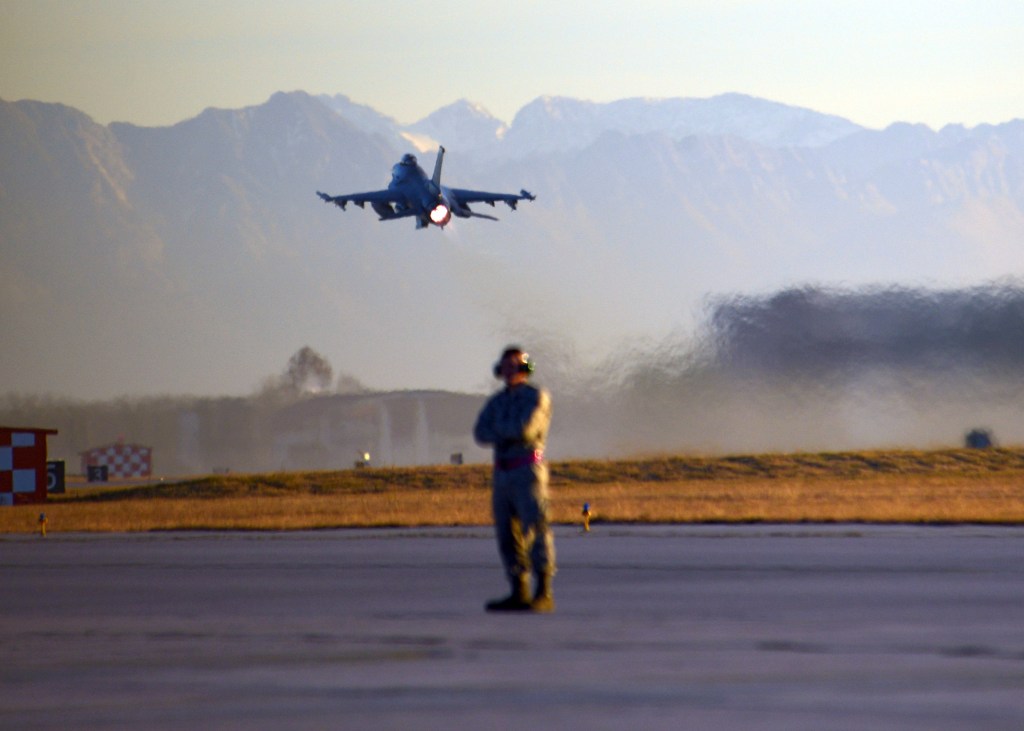
A U.S. Air Force F-16 Fighting Falcon aircraft departs Aviano Air Base, Italy
An F-16 of the USAF 31st Fighter Wing departs Aviano Air Base, Italy. Aviano is one of two bases in Italy and six in Europe to host American nuclear weapons, which would be carried to their targets by the 31st’s F-16s in the event of war. (Photo via USAF/Wikimedia)

In mid-June, Ireland held a “consultative forum” on the future of the country’s security policy writ-large, particularly regarding the longstanding policy of military neutrality and whether it should be loosened or even abandoned in favour of greater security cooperation with other European states and NATO.

I can’t and won’t get into the weeds of the forum and the accompanying public debate. The whole thing was very complex and quite messy, and one could reasonably accuse many involved in the discussion of not operating in especially good faith. The key points are:

I don’t want to discuss the importance of Irish neutrality itself, what neutrality means in a discursive or political sense, the merits and downsides of the misleadingly-named Triple Lock, or whether there really is a covert political project underway to gradually move Ireland towards NATO membership. I have many thoughts on most of these (not really the last one), but there has been plenty of mostly-unproductive discussion on them already, and I don’t think my contribution would change much.

I do want to talk about the thing I always want to talk about: nuclear weapons. Namely, how do nuclear weapons – and Ireland’s legal and diplomatic position on them – shape the choices Ireland could make on its security strategy? What would the impacts of various policy options be on our international commitments? Does maintaining those commitments mean some policy options are off the table? I haven’t seen anyone delve into this yet, nor did it feature prominently in the public debate in June, and that strikes me as an oversight. So I’ll do my best.

Ireland’s nuclear position

Ireland is a state party to the Treaty on the Prohibition of Nuclear Weapons (TPNW), one of just four such state parties in Europe (the others being San Marino, Malta and Austria). The treaty was signed on 20 September 2017, and entered into force on 22 January 2021. There are 92 signatories in total, of whom 68 have ratified the treaty to become full state parties – almost all of them in the Global South, especially Africa and South America. The treaty does a lot of things, but mostly it’s notable because it makes the possession of nuclear weapons illegal. Its first article reads:

1. Each State Party undertakes never under any circumstances to:
(a) Develop, test, produce, manufacture, otherwise acquire, possess or
stockpile nuclear weapons or other nuclear explosive devices;
(b) Transfer to any recipient whatsoever nuclear weapons or other nuclear
explosive devices or control over such weapons or explosive devices directly or
indirectly;
(c) Receive the transfer of or control over nuclear weapons or other
nuclear explosive devices directly or indirectly;
(d) Use or threaten to use nuclear weapons or other nuclear explosive
devices;
(e) Assist, encourage or induce, in any way, anyone to engage in any
activity prohibited to a State Party under this Treaty;
(f) Seek or receive any assistance, in any way, from anyone to engage in
any activity prohibited to a State Party under this Treaty;
(g) Allow any stationing, installation or deployment of any nuclear
weapons or other nuclear explosive devices in its territory or at any place under its
jurisdiction or control

Treaty on the Prohibition of Nuclear Weapons, 20 September 2017

Ireland’s support for this treaty is commendable. Nuclear weapons are dangerous, and while the TPNW on its own has thusfar failed to convince the nine nuclear-armed states to begin working towards disarmament (despite them being separately legally required to under the Treaty on the Non-proliferation of Nuclear Weapons [Non-Proliferation Treaty, NPT]), it adds to the “nuclear-taboo”, the international norm of seeing nuclear weapons as an illegitimate tool of state power the use of which is impermissible.

Ireland is not just a passive party to the TPNW: we helped to write it and are among its most enthusiastic cheerleaders. Ireland has been pushing for an international ban on nuclear weapons from at least 1998. When negotiations on the TPNW’s text began in 2017, we hailed it as “taking the opportunity to write a new history and in so doing to create a new, more stable, more secure and more equal future for all,” and at the conclusion said it was a “ground-breaking treaty” and a “truly historic day at the United Nations.” The International Campaign to Abolish Nuclear Weapons, recipient of the 2017 Nobel Peace Prize, named Ireland, Austria, Brazil, Mexico, Nigeria and South Africa as the “core group” of states which led the negotiations to a successful conclusion.

In August 2020, just before Ireland ratified the TPNW, then-Minister for Foreign Affairs Simon Coveney wrote an op-ed in the Irish Times in which he laid out Ireland’s position on the nuclear issue very clearly:

“Ireland’s ratification of the treaty reflects our deep concern about the catastrophic consequences of a nuclear explosion and the sheer impossibility of any adequate humanitarian response. This has led us, as a country, to our deep-rooted conviction that we must ensure nuclear weapons can never be used again under any circumstance. Nuclear disarmament has long been a feature of Irish foreign policy. (…)

Ireland will continue to work for the elimination of nuclear weapons and to ensure the most powerful and most indiscriminate weapons of mass destruction ever invented have no place in the security doctrine of any state. The very existence of nuclear weapons threatens us all. There can be no right hands for the wrong weapons. The only guarantee of protection from nuclear weapons use is their complete elimination.”

Simon Coveney* in the Irish Times, 6 August 2020

Since the treaty’s signing, Ireland has voted for the annual UN resolution calling on non-participating states to join the treaty. Since the TPNW’s entry into force, Ireland has acted as an official facilitator of important discussions on its implementation. In September 2022, we reiterated at the UN that our support is “driven by our concern for the devastating humanitarian consequences of any use of nuclear weapons, including the disproportionate impact on women and girls”.

Coveney was entirely correct when he noted that Ireland’s strong anti-nuclear conviction goes back a long time. The process of negotiating the NPT, probably the single most important and successful international arms control treaty in history, was launched by Frank Aiken – former Anti-Treaty IRA Chief of Staff, Fianna Fáil TD**, and then-Minister for External affairs – in 1958. Seán MacBride, another former IRA Chief of Staff who later became Minister for External Affairs, launched the Appeal by Lawyers Against Nuclear War and successfully lobbied the International Court of Justice to hand down an opinion confirming that threatening use of nuclear weapons was likely illegal under international humanitarian law.

Frank Aiken signs the NPT, surrounded by a crowd of delegates from various countries
Minister for External Affairs Frank Aiken is the first person to sign the NPT, at a ceremony in Moscow in 1968. (Photo from Frank Aiken Papers, Archives, University College Dublin, item number P106/6942)

Ireland has a proud history of being an international leader on issues of nuclear arms control and disarmament. Opposing ongoing possession of nuclear weapons and pushing for their abolition has been a core tenet of our foreign policy effectively since there have been nuclear weapons. The Department of Foreign Affairs calls it “an historic, long-standing priority for Ireland … motivated by the immense human suffering which would arise from the detonation of a nuclear weapon, whether by accident, miscalculation or design.” The TPNW is not just a legally-binding treaty to which we are a member, it’s the most recent part of a long, proud Irish legacy of campaigning against nuclear weapons.

Crucially, as the recent statements quoted above make clear, Ireland opposes nuclear weapons not just because we (rightly) believe that nuclear weapons are detrimental to Ireland’s own security and interest; indeed, self-concern is notably absent from our rhetoric. Ireland is anti-nuclear we have established as an underlying of our foreign policy that the existence of these weapons is wrong as such. Our anti-nuclear stance is therefore not a means by which our defence goals are achieved, but a goal in and of itself.

This is, to editorialise explicitly, a very good thing and something we should take much more conscious pride in than we do.

* Stopped clocks etc.

** And again

Europe, NATO, and nukes

We need to talk about NATO. It is not the only game in town when it comes to European security; the EU has a security policy, sort of, and undertakes its own training and overseas missions, sometimes (and I hear there are even non-NATO, non-EU countries, but we’re going to skip those for now). But with the accession of Sweden and Finland to NATO, there are just four EU states not in NATO: us, Austria, Cyprus and Malta. Thus the nuclear policy of NATO is the nuclear policy of the other 23 EU states, the UK, Norway, Iceland, Albania, Montenegro, Macedonia, and Turkey (and the US and Canada). NATO contains a three of the world’s nine nuclear-armed nations, two of which are in Europe, and the other of which deploys its weapons on the territory of five European states (Germany, the Netherlands, Belgium, Turkey and Italy). Thus if we are going to talk about Ireland, European security and nuclear weapons, NATO is pivotal.

NATO has been, since its inception, a fundamentally nuclear organisation. It was created to commit the US to the defence of Western Europe in case of a Soviet invasion, which western powers perceived to be a constant risk. Given NATO’s inferiority to the Warsaw Pact in conventional forces basically throughout the Cold War, the “nuclear umbrella” provided by the US’s weapons was consciously and explicitly a cornerstone of the alliance’s strategy, to deter conventional as well as nuclear threats.

But the Cold War is over. So what role does NATO see nuclear weapons as having in the 21st century? The alliance’s 2022 Strategic Concept, its core policy document unanimously approved upon by member states last year, discusses this:

28. The fundamental purpose of NATO’s nuclear capability is to preserve peace, prevent
coercion and deter aggression. Nuclear weapons are unique. The circumstances
in which NATO might have to use nuclear weapons are extremely remote. (…) The Alliance has the capabilities and resolve to impose costs on an adversary that would be unacceptable and far outweigh the benefits that any adversary could hope to achieve.

29. The strategic nuclear forces of the Alliance, particularly those of the United States, are the supreme guarantee of the security of the Alliance. (…) NATO’s nuclear deterrence posture also relies on the United States’ nuclear weapons forward-deployed in Europe and the contributions of Allies concerned.

30. NATO will take all necessary steps to ensure the credibility, effectiveness, safety and
security of the nuclear deterrent mission. The Alliance is committed to ensuring greater integration and coherence of capabilities and activities across all domains and the spectrum of conflict, while reaffirming the unique and distinct role of nuclear deterrence. NATO will continue to maintain credible deterrence, strengthen its strategic communications, enhance the effectiveness of its exercises and reduce strategic risks.

NATO 2022 Strategic Concept, 30 June 2022 (emphasis added)

On the TPNW specifically, we can turn to the joint statement, again unanimously approved by members, during last week’s NATO summit in Lithuania:

53.   NATO Allies support the ultimate goal of a world without nuclear weapons (…) achieved in an effective and verifiable way that promotes international stability and which is based on the principle of undiminished security for all. (…)

54. We reiterate that the Treaty on the Prohibition of Nuclear Weapons (TPNW) stands in opposition to and is inconsistent and incompatible with the Alliance’s nuclear deterrence policy (…) and does not take into account the current security environment. (…) We do not accept any argument that the TPNW reflects or in any way contributes to the development of customary international law.  We call on our partners and all other countries to reflect realistically on the ban treaty’s impact on international peace and security (…) and join us in working to improve collective security through tangible and verifiable measures that can reduce strategic risks and enable lasting progress on nuclear disarmament.

NATO Vilnius Summit Communiqué, 11 July 2023 (emphasis added)

Finally, the three nuclear-armed states of NATO released a tripartite statement during the negotiation process for the TPNW:

France, the United Kingdom and the United States have not taken part in the negotiation of the treaty on the prohibition of nuclear weapons. We do not intend to sign, ratify or ever become party to it (…) This initiative clearly disregards the realities of the international security environment.  Accession to the ban treaty is incompatible with the policy of nuclear deterrence, which has been essential to keeping the peace in Europe and North Asia for over 70 years. (…) A ban treaty also risks undermining the existing international security architecture which contributes to the maintenance of international peace and security. (…) Working towards the shared goal of nuclear disarmament and general and complete disarmament must be done in a way that promotes international peace and security, and strategic stability, based on the principle of increased and undiminished security for all. 

Joint Statement of the United States, United Kingdom and France, 7 July 2017 (emphasis added)

None of this is surprising. If a key role of NATO has always been to provide a nuclear umbrella to European countries and it continues to see nuclear weapons as the “supreme guarantee” of its security, of course it would be hostile to the TPNW – the stated goal of which is to stigmatise the possession of nuclear weapons. Despite the insistence that NATO and the nuclear states within it “support the ultimate goal of a world without nuclear weapons”, the weapons are a solid plank of allied security policy right now, and the plan is to maintain that indefinitely (“NATO will continue to maintain credible deterrence”). Thus most measures intended to bring a nuclear-free world closer to realisation, such as strengthening norms against nuclear weapons, represent a threat to that security policy. Hence the vehemence of the Vilnius statement (which comes out even more strongly in the full text).

Ireland’s future in European security

Where does that leave Ireland? It shapes our options on how we interact with the ecosystem of European security. I want to examine how, by looking at the implications for our TPNW and broader nuclear commitments of three possible future Irish strategies: continued strict neutrality, joining NATO, or something in between.

Neutrality

The status quo is, unsurprisingly, the most straightforward scenario. If we continue being a neutral country with very little military involvement abroad except that sanctioned by the UN Security Council (UNSC), our TPNW compliance and anti-nuclear stance are not impacted. I would argue, and there is some evidence to corroborate this, that our neutrality accords us soft power in general and credibility on the particular subject of international conflict peace. Thus continuing to be neutral does not just not compromise our anti-nuclear position, it significantly increases our potential to continue spearheading global arms control and disarmament efforts. I do not think we would could have led the charge on the NPT in the 60s if we hadn’t been a neutral country. While it’s certainly possible some other country would have stepped up if we hadn’t, we did, and the treaty we helped broker has been (despite its many problems) stunningly successful at limiting the spread of nuclear weapons and keeping the world safe. So that’s pretty nice.

NATO Membership

I am not an expert in international law; I’m not qualified to say whether, legally, Ireland joining NATO would constitute a technical breach of our TPNW obligations. But any common-sense reading of both the treaty and NATO’s Strategic Concept shows the two to be incompatible. You cannot sign off on a document that says “NATO will take all necessary steps to ensure the credibility, effectiveness, safety and security of the nuclear deterrent mission” and claim to not “assist, encourage or induce, in any way, anyone” to “develop, test, produce, manufacture, otherwise acquire, possess or stockpile nuclear weapons” or “use or threaten to use nuclear weapons”. To sign up to be under a nuclear umbrella is to encourage the possession of and threat to use nuclear weapons, on an ongoing basis. In many ways it doesn’t matter whether this could be proven to be a technical violation of the treaty; the TPNW does not provide for sanctions for any breaches of its terms. The consequences are purely political, and thus if something is widely perceived to constitute a breach, it is a breach.

Thus if Ireland were to join NATO, we would have to breach the TPNW. Both the preamble of the treaty and the rhetoric Ireland has used in support of it are so forceful, so completely unequivocal, that we would already have supplied the ultimate criticism of our own actions before they happened. We would look pretty bad.

We could try to avoid this by withdrawing from the TPNW. A state may withdraw by giving twelve months’ notice “if it decides that extraordinary events related to the subject matter of the Treaty have jeopardized the supreme interests of its country”. Withdrawing would allow us to argue we are not a state that reneges on its international legal obligations. On the other hand, it would be extremely difficult for us to credibly argue that Ireland is dealing with “extraordinary events” which have “jeopardized [our] supreme interests”. While the world is more dangerous than it was in 2020 when we ratified the treaty, it is not really sufficiently more dangerous abrogate what we have established as inalienable humanitarian principles. It’s also not especially more dangerous than the darkest days of the Cold War, when we were espousing those same principles, so our reasoning would be pretty self-evidently hollow.

Giving a clearly insincere justification for withdrawing is not that much better than breaching the treaty (or inventing a weak interpretation of the treaty with which to insist we’re not breaching it) and all the self-criticism still applies. And it might be worse: Ireland would become the first country in the world to withdraw, and in so doing call huge amounts of attention to our backtracking.

The government of Norway commissioned a study on the potential of it joining the TPNW. It contains numerous criticisms of the TPNW, which I profoundly disagree with, but its section on the interaction between the treaty and Norway’s NATO obligations constitutes the only such opinion commissioned by a NATO government, and is worth reading:

It is clear that if Norway ratified the Treaty on the Prohibition of Nuclear Weapons, it would acquire new obligations that would be incompatible with its political obligations under NATO. Nato’s 2010 Strategic Concept , the 2012 Deterrence and Defence Posture Review (DDPR) and the Nato summit communiqués provide the framework for the political obligations Norway has as a Nato member. These documents have been unanimously adopted at Nato summits by NATO heads of state and government.

These documents establish that NATO supports the goal of creating a world without nuclear weapons, but make it clear that Nato will remain a nuclear alliance as long as nuclear weapons exist. (…)

Article 1 of the Treaty on the Prohibition of Nuclear Weapons also prohibits nuclear deterrence as such (Article 1, (d), (e), (f), (g)). This is in direct conflict with Nato’s deterrence posture, as expressed, for example, in NATO summit communiqués. It would therefore be difficult for a country that has ratified the Treaty to endorse the summit communiqués as they are worded today.

In the past, there has been open disagreement in NATO about its nuclear deterrence policy. This was particularly apparent in 1979 when Nato made its dual-track decision. The countries that had reservations about the decision expressed this through dissenting footnotes in various subsequent NATO declarations. This footnote policy significantly weakened the influence of the countries concerned on NATO policy, and undermined unity within the Alliance.

In a statement issued on 20 September 2017, the North Atlantic Council made it clear that the Alliance does not support the Treaty on the Prohibition of Nuclear Weapons.

Review of the consequences for Norway of ratifying the Treaty on the Prohibition of Nuclear Weapons, 28 November 2018 (emphasis added)

These latter two paragraphs are notable. It might theoretically be possible to carve out a space within NATO for countries objecting to and wishing not to be covered by nuclear deterrence; next time a strategic concept is drawn up, Ireland could insist an asterisk be put on the deterrence portion. Certainly, some disarmament advocates hope that existing NATO member states in which there is a strong anti-nuclear movement can be convinced to move into this position.

But there is a vast difference between carving out a space for existing NATO members who have gotten nuclear cold feet (not least because there is no mechanism to kick states out of the alliance, and most major decisions require unanimity) and admitting a member you know will cause that problem and have to be accommodated. I would wager NATO wouldn’t be willing to do that, for two reasons. First as the Norwegian report acknowledges, the Double-Track issue of late 70s/early 80s is now regarded as having been a time of profound discord, is often described as a “crisis”, and is believed by some to have almost destroyed NATO. Second, it’s not just that Ireland and NATO don’t quite see eye-to-eye on deterrence; Ireland was a lead negotiator on a treaty that NATO went out of its way last week to unanimously, forcefully condemn as totally bad, wrong, and completely opposed to what it stands for.

Based on that, my guess is that NATO would simply make adherence to their nuclear policy a condition of membership. The Swedish government thinks the same. Their report in 2019 said “the accession of Sweden to the TPNW would without any doubt prevent a possible future Swedish membership of NATO. This situation would remain the same as long as NATO remained a nuclear alliance.” [emphasis added] It, like the Norwegian report, calls NATO “a nuclear alliance”. That’s key, I think; even if by some miracle we could get a special exception to join the alliance but have it on record that we don’t endorse its nuclear policy, does that mean anything? It’s a nuclear alliance. It’s always been a nuclear alliance. If we join it anyway, achieving no change to its policy but rhetorically registering our objection to that policy, clearly our objections aren’t actually that strong. If the treaty is about political messaging, we would clearly have abandoned the political message.

Not very many people support NATO membership for Ireland (the last poll put it at about 14%), and it is not the platform of any significant political party (though there is a sense that many in Fine Gael and Fianna Fáil would be amenable to it if they thought the political climate was more favourable). It does not seem likely to happen soon. But if and when it is discussed seriously, it must be acknowledged that such an option would require Ireland either to break international law or to withdraw from a landmark treaty we helped write.

Something in between

The compromise option is hardest to analyse, not least because it could manifest in a range of different ways. It probably looks like an Ireland which is not a member of NATO or any other alliance, but has much looser legal limitations on deployment of military force abroad, and is willing to participate in exercises and missions with the EU and/or NATO even when missions are not sanctioned by the UNSC. This overseas activity could be very extensive or very limited. It probably bears similarities to pre-2022 Sweden and Finland; the former participated in NATO missions in Libya, both eschewed the terms “neutral” and “non-aligned”, and Finland specifically said: “We are not a neutral country, we have not been so for the past 20 years. And we are not a militarily non-aligned country but we are a country which does not belong to a military alliance.”

The fact that both Finland and Sweden are now in (or practically in) NATO suggests that this “in between” position may not be a stable one, but one which tends to push states towards NATO membership. On the other hand, Ireland is small island very far away from Russia and therefore less likely to feel the same sense of danger that prompted these two countries’ accession. Defining the bounds of neutrality and the multilateral security options available to non-NATO European states is very complicated, and not something I can or want to comprehensively tackle here, but it’s necessary to imagine some of the possibilities to think about how it might intersect with the nuclear issue.

If clear-cut neutrality permits compliance with the TPNW and the chance to continue anti-nuclear leadership, and NATO membership would constitute a clear and gross violation of the TPNW, something in between offers us…something in between. I said above that the TPNW is intended to shape norms, and the effects of compliance with it or violation of it are primarily political rather than legal. In that sense, aligning but not allying ourselves with anti-TPNW states would weaken our pro-TPNW position but not totally reverse it. The extent of that weakening would be dependent on the extent of that alignment. For example, participating in NATO missions would mean Irish forces operating under the command of an organisation which is institutionally anti-TPNW; that would compromise significantly our leadership on the treaty’s implementation and, I would argue, come close to “encouraging” the possession of nuclear weapons. Participating only in EU activities would require less compromise but certainly not none, given five of the EU’s richest and most influential states own or host nuclear weapons. Irish air units forming permanent integrated command structures with French and German units which also have nuclear missions is probably not a treaty violation, but it’s not a good look either.

To move beyond the messaging and into actual legal issues, we must once again acknowledge that I am not a lawyer, and get some help. When Sweden wrote its TPNW report, it was in the “not-neutral but not-allied” position, so it is worth examining here.

Provisions of the Treaty will affect many sectors of society owing to the dual-use nature of knowledge, components and activities related to nuclear weapons that are also of importance in the civilian domain or in the context of conventional defence. More aspects currently prohibited by the Treaty may be of relevance to nuclear weapons than is commonly realised. (…)

The general and global security policy implications alone of the Treaty are likely to have an impact on the conditions for Sweden’s security and defence cooperation with partners. The disarmament and defence clusters taken together with the way the Treaty is formulated (broad scope, lack of definitions, etc.) in turn make it more complicated for Sweden to develop a national compliance system that is credible over the long term and provides legal certainty. (…)

Swedish accession would, not least in view of the nuclear umbrella issue, necessarily be perceived as a fundamental criticism of the strategic doctrine subscribed to by almost all of Sweden’s neighbours and partners in NATO. In this context, Sweden would no longer be perceived as like-minded (…)

In situations where Swedish participation in exercises or a staff presence abroad is under consideration or when foreign military visits to Sweden are being discussed, uncertainty concerning the interpretation of the Treaty, including on the part of foreign actors, could delay decisions or make them impossible. (…)

Accession may also be expected to lead to a stagnation of current Swedish cooperation with NATO and bilaterally with NATO members. They may be expected to hesitate to maintain the current high level of cooperation with Sweden, should Sweden accede to the Treaty. (…)

The prohibition of assistance is an issue of key relevance to most points in the terms of reference. The prospects of achieving unity on the interpretation of this concept at different levels (in Sweden, in the EU, among States Parties and globally) are currently poor.

Inquiry into the consequences of a Swedish accession to the Treaty on the Prohibition of Nuclear Weapons, January 2019 (emphasis added)

There are several things to note about this. It highlights the same “dual-use” problem I mentioned in the context of air forces above. It was written in the context of Sweden wanting to keep the door to NATO membership open and is not shy about that fact; discussions of the difficulty of continuing to cooperate with NATO under the treaty may be more to do with that, and might apply less to countries not intending to ever join NATO. I am also not sure that the report is correct to say that NATO would less or unwilling to cooperate with a TPNW state, especially post-2022 – if they would, then this option would require us to withdraw, and we have the same problems as with NATO membership above.

Nonetheless, I am inclined to believe the report when it says that there is a way to interpret the word “assist” so that any state party to the TPNW seeking military integration with a nuclear-armed state would need at the very least to be extremely careful not to stumble into legal trouble. There are, I think, possible versions of international military alignment short of NATO membership that would constitute a violation of Ireland’s TPNW commitments. The Irish government would need to put in place a clear regulatory framework to prevent such violations occurring, and Irish civil society would need to keep watch to ensure the state did not accidentally, negligently or cynically renege on those commitments.

Ultimately though, it mostly is about signalling. At the absolute least, abandoning neutrality in favour of closer security alignment with our European neighbours must raise questions about what values that security policy serves. We have stated that our values on nuclear weapons are unequivocally negative, and that this is an urgent humanitarian issue to us. All NATO members have stated that they are irreconcilably opposed to our stance, and that maintenance of nuclear weapons in European defence is, for now, of “supreme” importance to them. What are we saying about the strength of our convictions in that case? Would we be able to ensure that the force of our stance is maintained as we integrate into a collective EU security strategy, or would it become watered down and increasingly forgotten? I certainly hope it wouldn’t, but given I heard no mention at all of this issue during the debate in Ireland in June, I’m not so sure. The current government is the same one that ratified the TPNW in 2020, but it has also been signalling clearly that it would favour less or no neutrality, with no mention of how to maintain TPNW compliance and leadership on disarmament. That worries me a lot.

I’m not saying we couldn’t find a “middle ground” security strategy that kept our TPNW commitments and didn’t compromise our anti-nuclear leadership. I’m just saying it might be a little difficult, and I am concerned we might not even remember to try. And if we don’t, and end up watering down our stance on what’s supposed to be one of our most dearly-held values, we are going to lose a good chunk of our soft power, our reputation as an international peacemaker and broker of treaties. Reputation matters, and in that sense states are like people: no one likes the flaky ones.

Conclusion

In essence, my worry is that though we have rhetorically and diplomatically established a strong opposition to nuclear weapons as a sacred and fundamental Irish value, we seem ready to forget that the minute we leave the UN General Assembly chamber. It’s an unassailable principle, until there’s something else we might want, at which point it doesn’t even enter our minds.

Ireland’s commitment to bringing about a nuclear-free world is something we should be immensely proud of, and we must not sacrifice or compromise it in favour of being “good Europeans” or better politically integrating ourselves with the rest of the West. We may be in a small minority in having this position in Europe, but the rest of the world – especially the Global South – looks very different. Even in Europe, governments’ positions do not tell the whole story: more than three quarters of the population in Belgium, Denmark, Iceland, Italy, the Netherlands and Spain support joining the treaty, for example.

If and when we restart significant public discussion of Ireland’s future security policy, I would like to see TPNW compliance and anti-nuclear leadership not only brought up in the discussion, but front and centre; I would like that discussion to be framed as how to ensure we proceed in a way consistent with our values, not about the best way to justify casting those values aside.

The TPNW is an aspirational document. It’s about setting an expectation for world should be, and then working to make the world meet it. It’s throwing our collective caps over the wall. Ireland has set a standard for ourselves too. Let’s live up to it.

What Mariama Diomande can teach us about social cohesion

Jack Kennedy (EPLO)'s avatarEuropean Peacebuilding Liaison Office Blog

By Jack Kennedy

In the new EPLO documentary, “MARIAMA”, we meet Mariama Diomande, a young Ivorian woman who has dedicated herself to building peace in her community in Abidjan, in the wake of the violence that engulfed Côte d’Ivoire following the 2010 election. Mariama’s story is inspiring; it is a demonstration of what a small group of determined, civic-minded people can do if they put their minds to it. It is also about the marks left by the conflict, and the hopes that Ivorians of all ages have for a better future.

More broadly, Mariama’s story is about the importance of social cohesion in communities trying to recover from and/or prevent conflict. It is a concept applicable across the globe, in a wide variety of post-conflict and conflict-vulnerable societies. Building social cohesion is key to the work of many of EPLO’s member organisations.

Social cohesion

What is social…

View original post 1,309 more words

Trinity, I love you but you’re bringing me down

This article was originally published in the April 12th 2022 issue of Trinity News, the final issue under my editorship. I hope you’ll forgive the uncharacteristic sentimentality.

With the conclusion of my term as editor approaching, I’m preparing to say goodbye to Trinity for good. That’s no small thing; I’ve been here longer than almost anyone who isn’t now actually teaching classes. I remember the buildings that used to be where the Business School is now. My student number begins with 15.

As I suffer from the kind of cloying nostalgia that comes with every major life transition, am I sorry to be leaving? Well, no, not really. The truth is, as much as I’ve loved (most of) my time here, Trinity is broken. It’s been that way for a long time.

This manifests in lots of ways. College’s unwillingness or inability to support its students is so profound and total that it’s literally killing people. It was noted at the last Trinity College Dublin Students’ Union (TCDSU) Council meeting on April 5 that there has been one suicide a year in the School of Medicine alone for the last four years running.

As has also been noted by TCDSU of late, College’s response to the tragic death of another medical student in February was to pass the buck to the union’s education and welfare officers. All 18,400 Trinity students were advised to lean on two people who, for the Trojan work they do in supporting their peers, are also just students and don’t have any professional training in trauma counselling. This is Trinity’s idea of fulfilling its duty of care to its students. Meanwhile, the actual Counselling Service’s waiting lists just keep growing, and the broader question of why students from every Trinity faculty are so desperately in need of counselling remains unanswered.

The relationship between College and its students isn’t just characterised by neglect, though, there’s also actual hostility; I’m old enough to remember Take Back Trinity, when it was necessary for student activists to occupy the Dining Hall to stop the university introducing huge, regressive repeat exam fees. This piece of recent history was on my mind of late, when the College Board had to be talked out of jacking up fees for international and postgraduate students next year. I would be surprised if they don’t try again once the agreed year of grace has passed. It’s also worth remembering that in 2019, Trinity used students as bargaining chips in funding negotiations with the government by threatening to cut its undergraduate admissions by more than a fifth.

Postgrads should never be forgotten, of course. The way College treats postgrad workers is nothing short of abusive. If it weren’t for the handy blurring of lines between employee and student, the conditions under which many casual teaching staff are obliged to work would be outright illegal and College would very quickly find itself in front of the Labour Court. Even if these practices are technically legal (which sometimes they’re not), it’s just an absolutely abhorrent way to treat people. Trinity burns the welfare and dignity of graduate students to save cash.

Other, basic parts of the student experience betray how deep the malaise goes. Whether it’s the tooth-pulling exercise of trying to get Trinity to hand over class timetables each year (which has been a fiasco as long as anyone can remember), the Kafkaesque nightmare of even the smallest interaction with Academic Registry, or the inevitable administrative car crash of exams every single semester, it’s evident College is barely functional. Every part of it is so underfunded and over-bureaucratised it’s a wonder the light switches work.

These aren’t individual, disconnected policy problems. It’s all part of the same issue. College is in the throes of a decades-long identity crisis and a struggle to secure its own future. Years of abject neglect by government have left universities across Ireland strapped for cash, and Trinity’s solution has been to lean hard on international students and tourism as sources of revenue, while imposing a kind of austerity on almost everything related to being an actual university. Meanwhile, as a four-century old institution, Trinity retains many administrative anachronisms and a deep institutional conservatism around its core functions and structures. 

The result is a paradox; Trinity badly wants to attract sightseers and students from across the world who can be charged staggering fees, but both of these things are dependent on its reputation as a respected institution of learning. But its single-minded pursuit of a positive public image at the expense of basic functionality and student experience makes that reputation increasingly difficult to maintain. Thus, cracks keep appearing in the facade and College keeps slipping down institutional rankings; the harder it pursues its goals, the more unachievable they become. Trinity is like a stressed-out snake eating its own tail. The centre cannot hold.

I don’t point any of this to lay blame at any one person’s feet, or because I have a proposed solution. It’s possible there never were good choices for Trinity to make given the situation it’s been put in by years of neoliberal consensus in Irish politics. College’s strategy is undoubtedly making things much worse of course, and it’s clearly wrong for the university to throw students under the bus to save its own skin, but it would also probably be very hard for it to reverse direction now. 

I think the rot goes all the way through. I don’t know how it could be fixed now without a genuinely seismic upending of how third-level education is run in this country, if not the entire political and economic system. People are right to keep fighting for change in College, but I worry that the root causes of these issues are bigger than all of us, and that we may be doomed to play activist whack-a-mole forever. It’s not just that College doesn’t give a shit about us, it’s that College is structurally incapable of giving a shit.

If you’ll permit me some uncharacteristic earnestness: I’ll treasure the memories of my time in Trinity for the rest of my life. Coming here and getting through my degree was the hardest and the best thing I’ve ever done, which is one of the reasons it took me so long. I’m walking away with friends and experiences that will define me for years or decades to come, and I just wouldn’t be who I am now without this place.

But I have the feeling about Trinity that I do about Ireland, these days: it never loved me back, and it never will, no matter how much I want it to.

I’ve had to find a way to accept that, while also accepting that I, and all of us, deserve more. In the words of Matt Damon’s eponymous character in Good Will Hunting: I’m holding out for something better.

How can you not be romantic about baseball?

This essay was originally published in the September 7th 2021 issue of Trinity News.

Keith Allison / Wikimedia Commons (CC BY-SA 2.0)

In school, I didn’t enjoy PE class. I was a weedy, asthmatic, bookish kid lacking the stamina and co-ordination that those two hours a week demanded of me. The problem only got worse once I reached second level, when I began to feel self-conscious and insecure in the hyper-masculine environment the likes of which only teenage boys can cultivate.

I wasn’t one for spectator sports either. I was mostly lost in discussions of football and rugby throughout my youth, despite a theoretical allegiance to Manchester United and Leinster, which I had really just inherited from my older brother and my county of birth respectively. It seemed like a fun thing to be interested in, and would doubtless have been a useful social shibboleth to have, but just didn’t do it for me.

But I always loved rounders. The most oft-forgotten GAA sport held, and continues to hold a special place in my heart. It was fast, exciting, and just manly enough without requiring me to throw or kick anything. The thud of a pitched tennis ball ricocheting off your racket and tracing a high arc across the park was enough to make anyone feel like Babe Ruth.

Perhaps it was nostalgia for moments like that which drove me towards baseball, years later, at the age of 20. What actually first caught my attention, though, was sabermetrics – the field of statistics as they relate to baseball. It’s a very unsexy and not at all romantic thing to be drawn to, but I like numbers. Numbers make sense. And baseball is full of numbers.

Like so many people, I saw Moneyball, and unlike many of those people, I was really very much drawn to the idea of winning a professional sporting title because you can write better Excel formulas than anyone else. I didn’t know anything about the sport, save that which I’d picked up on the rounders field, but I was of course familiar with its mythos and its place in US pop culture. And now I had an in.

So, I started reading through Wikipedia’s “Glossary of baseball terms” and watching old games on YouTube, and something strange started to happen. I started to get really into it. The team I’d arbitrarily picked to follow (on the basis that they’re sort of associated with NASA and space exploration, and I’ve always been a space nerd) went from an object of interest to one of pride and finally to one of almost religious importance.

I found myself staying up into the small hours of the morning to watch games taking place six time zones away (instead of staying up because I’ve always had a terrible sleep schedule). I bought a hat. I learned to yell “are you blind? There’s no f***ing way that was a strike!” at the TV. I became a sports person.

Baseball is not, on the surface, a very interesting sport. The average length of a major league game in 2021 is, according to Baseball Reference, three hours and eight minutes. The longest game of this season so far was a bit over five and a half hours, two weeks ago. Most of that time the game isn’t even being played. Hitters are adjusting their bat grip and taking practice swings, or pitchers are kicking at the dirt on the mound and spitting. The fans in the stadium spend a lot of the game talking to each other, drinking beer, and eating hot dogs rather than being enraptured by the action.

So what’s the appeal? Maybe we love baseball because of its emotional heights. When Tom Hanks’ character in A League of Their Own shouted “there’s no crying in baseball!”, he could scarcely have been more wrong. I watched my beloved team lose (deservedly, unfortunately) in the final game of the 2019 World Series, at 4am, alone in my darkened kitchen. I’ve watched millionaire athletes sob or punch each other over the outcome of just one of each season’s 162 games. I know there is, in fact, a lot of crying in baseball, and every other kind of emotional outburst besides.

Because though baseball is slow, it makes up for this by concentrating all the excitement, tension, and pressure into one or two crucial moments a game. You can physically feel it, that tightness in your chest, as the hitter steps up to the plate in the bottom of the ninth inning. There are two outs, his side is down by a couple runs, the bases are loaded, and it’s the last game of a postseason series. You could be a hundred metres away in the stands or a thousand kilometres away watching a livestream, but when the batter and the pitcher lock eyes across 60 feet and six inches of grass and dirt and the whole stadium goes quiet, you might as well be standing behind home plate. And in just a moment, one team will explode into expressions of ecstasy, and the other will feel the bottoms of their stomachs drop. 

Hanks’ Jimmy Dugan was getting at something, though. So often the game is struggling with questions like whether grown men are allowed to cry. It speaks to something that all of the baseball stories in popular culture are partially about masculinity in crisis. Dugan (while not the star of the movie) angry and wretched, trying to get to grips with having his meteoric career shattered by alcoholism. Brad Pitt’s Billy Beane in Moneyball has never really recovered from his career never really taking off, and can’t figure out who he is if not a baseball player. The entire plot of Field of Dreams, supposedly the only film it’s popularly permissible for men to cry at, is about a guy who just wanted to play a game of catch with his now-deceased father.

Baseball, and by extension baseball movies, is the stage on which American men play out the drama of their inner lives, because they don’t know how or where else they could. Not only is there crying in baseball, perhaps baseball is the only place you get to cry.

But often-times, baseball doesn’t need us to write our personal stories in the margins. It has plenty of drama of its own. On 24 August 1919, Ray Caldwell, in his first game pitching for Cleveland, was getting ready to throw the final out of the game when he was struck by lightning. The bolt knocked off the catcher’s mask and the third base coach’s hat, and drove Caldwell to the ground. Many onlookers reported feeling a tingling sensation and their hair standing on end for several minutes after. After a moment, Caldwell got back up, dusted himself off, pitched, and forced a groundout to win the game.

Caldwell survived mostly unscathed, but a year later his teammate Ray Chapman would become the only person to date to be killed during a major league game, when he was struck in the head by a pitch.

But in terms of single pivotal moments that reinforce Billy Beane’s rhetorical question in the title of this article, perhaps nothing compares to game seven of the 2016 World Series. The Chicago Cubs were facing Cleveland, both teams had won three of the first six games, and the game was tied at six runs each after nine innings. The Cubs hadn’t won a national title in 108 years. When they won their 1908 World Series, the Ottoman Empire still existed.

With the game tied after nine, it would have to go on to extra innings. But then it started raining. Ohio’s Progressive Field isn’t a ballpark with a roof, so play had to be stopped.

It was just a comparatively short, 17-minute rain delay, but no doubt a tense one as the Cubs retreated to the visitors’ locker room. The players may have been thinking about the last time their team had reached the World Series but failed to win, in 1945. Or maybe the time before that, in 1938, or any of the other five times in 1935, 1932, 1929, 1919, and 1910. They may have been feeling a certain amount of pressure not to add an eighth entry to that list of almosts.

So Cubs right fielder Jason Heyward gathered his teammates together. He told them he loved them and that he was proud of them. He told them they were brothers, and that they had to look inside and remember all that each of them had done during the season to get to that moment. He said: “We’re the best team in baseball, and we’re the best team in baseball for a reason. Now we’re going to show it.”

“I don’t know how it’s going to happen, how we’re going to do it, but let’s go out and get a win.”

And they went out and got it. Once the game restarted, the Cubs immediately batted in two runs and won their first World Series in 108 years.

I never thought I’d become a sports fan. Ray Caldwell never thought he’d be struck by lightning. Jason Heyward probably never thought he’d almost single-handedly break his club’s century-long curse. But in baseball as in life, everything can change in a single moment.

“There’s no going back”

Protestors in Babrujsk assemble in front of a statue of Lenin on August 16th 2020.

This article was originally published in Trinity News on November 22nd 2020.

Many of his own people call Alexander Lukashenko “the Cockroach”. Foreign media outlets frequently refer to him as “Europe’s last dictator”. He freely admits to having “an authoritarian style of rule” and until this year, he was the only person to hold the office of President of the Republic of Belarus since the country’s independence from the Soviet Union. But that may soon change. His grip on power, seemingly unbreakable for the last 26 years, is suddenly slipping in the face of unprecedented popular resistance.

When Art Balenok and Yuliya Aliakseyeva log onto our Zoom call, there is a white-red-white horizontal striped flag behind Balenok’s desk. The flag, which represented Belarus between 1991 and 1995 and the short-lived Belarussian People’s Republic of 1918-19, has become a symbol of popular resistance to the Lukashenko regime. This year, it’s been most frequently seen flying over crowds of protestors staring down armour-clad Militsiya – the national police force of Belarus.

Balenok, a journalist, and Aliakseyeva, who works in Trinity’s Buttery restaurant, are part of a Belarusian diaspora group in Ireland that has come together since July to mobilise support for pro-democracy protestors at home. Aliakseyeva estimates there are no more than a thousand Belarusians in total living in Ireland, and “we’re talking about 50, maybe 70 people who are really involved” in the group.

“Most of us didn’t really know each other before August or July,” Balenok says. “What the events of August 9 triggered was a never before seen unification of all Belarusians, within Belarus and outside Belarus.”

He’s referring to Belarus’ most recent presidential election. Since taking office in 1994, Lukashenko has claimed victory in five elections, none of which have been regarded as legitimate and free by international observers. This year was no exception. The voting was marred by violence, blatant electoral fraud, and the arrest of campaigners and independent observers.

The day after the vote, government officials and Belarusian state media announced that the president had won an almost comical 70-point victory over the main opposition candidate, Sviatlana Tsikhanouskaya, on 84% turnout. Tsikhanouskaya was, up until this year, a teacher and an interpreter with no prior experience of advocacy or political ambitions. She entered the race in May after her husband, blogger and activist Siarhei Tsikhanouski, was imprisoned for “organization or preparation for a grave breach of public order.”

Pro-democracy demonstrations had been held on-and-off since Tsikhanouski’s arrest in May, but with the announcement of the bogus election results, they erupted. “We all came together and became Belarusian, all of a sudden” says Balenok. “Each one of us on that night said to ourselves ‘what can and what am I going to do to help.’”

Belarus experienced waves of popular protest in both 2011 and 2017, but this year’s numbers have dwarfed any seen before. Estimates of the number of protestors in the streets on the biggest days range from 200,000 to more than half a million, out of a population of just 9.4 million. More than 25,000 people have been arrested, at least six killed, and hundreds injured.

“Everyone, everyone has been affected. People from every social class in the country – factory workers, teachers, doctors, pensioners, students, young people,” says Balenok. “Everyone knows someone who has been arrested or who is still in prison.” The universality of  the anger at the Lukashenko regime is reflected in the diversity of groups who’ve joined together to oppose him. Women’s groups, conservative Christians, social democrats, greens, and anarchists are just some of the factions who make up the opposition. Even small groups of Minsk municipal police officers have laid down their riot shields, refused to follow “criminal orders”, and recognised Tsikhanouskaya as the country’s leader.

Aliakseyeva and Balenok cite two key factors that differentiate this year’s protests from previous movements. The first is simply build-up; the protests in 2011 and 2017 were “so brutally suppressed, so quickly” according to Aliakseyeva, but people’s grievances continued to mount. “There was not enough critical mass of people” willing to stand in opposition, she says. “But it was all milestones that were leading to today. Everything that was happening at that time was generating momentum that was brought to the election, when it all exploded.”

The second factor is Covid-19. “The way the government handled the pandemic was atrocious,” says Balenok. Lukashenko made international headlines frequently over the past year for his dismissal of the pandemic, calling it “psychosis” and suggesting citizens visit the sauna or drink vodka “to poison the virus”. Balenok describes ordinary Belarusian citizens having to raise money to buy protective equipment for healthcare workers as the government refused to take the virus seriously. “It was people in Belarus who made things happen, and I am sure they saved a lot of lives.”

But the election was “the catalyst”, he says. “We always knew that this was happening. We turned a blind eye. But this year it was just too blatant.” And since then the country has been locked in “civil war, revolution, whatever one may want to call it“. Government forces continue to violently suppress demonstrations, with the United Nations Human Rights Office documenting upwards of 450 instances of torture in August alone. But protestors keep marching, night after night.

“You are constantly on Telegram, checking the news and YouTube, trying to think what you can do to help” says Aliakseyeva, on the experience of watching all this from afar. “We are all badly affected.” Balenok concurs, adding, “It’s as though we were there. Sleep has been affected quite badly. Overall my mental state has not been good at all.”

They’ve been in constant contact with friends, family members and others in Belarus as events have been unfolding. “People have been traumatised for life,” Balenok says. “The price has been so high that whoever takes part believes there is no way back anymore. The situation is never going to be the same as it was before election night.”

Within both the wider protest movement and the Irish group, there is a big emphasis placed on consensus. “We don’t have individual leaders. We don’t want them,” Balenok says. “There has been one of those for the last 26 years in Belarus.”

Nevertheless, they speak admiringly of Ms. Tsikhanouskaya. The opposition activist has rejected the results of the election, estimating that she received 60-70% of the actual vote, and worked from exile in Lithuania and Poland to gather international support. A few days after the election, she founded the Coordination Council, to develop “safe and stable mechanisms ensuring the transfer of power in Belarus.” The European Union and the United States have since ceased to recognise Lukashenko as the legitimate president of the country, and called for new elections.

“The way people feel about her has changed during the last few months,” says Aliakseyeva. “She was starting as a housewife, never taking part in politics. Since then she’s changed dramatically. She’s gathered a lot of very smart, intelligent and good people around her.”

“She’s openly said she’d like to go back home and continue making burgers for her kids,” says Balenok. “Her only presidential program was to become a transitional leader to take the country to a proper free and fair election.” He adds that “her goal was never to become president or to get personal power.”

This emphasis on grassroots organising is reflected in how the Irish diaspora group operates. The initiative wasn’t the brainchild of any individual person but came together organically. “We had a few protests in Dublin and other towns, before there was lockdown,” says Aliakseyeva. “People got to meet each other and make connections. We organised ourselves on a Telegram channel and tried to involve people from a Facebook group for Belarusians in Ireland.”

“All the diasporas are talking to one another now” Balenok adds, “trying to find common ways and effective ways of helping the country and helping the people.” Ireland’s Belarusian community is relatively small, the pair say, compared to those in places like Canada, the UK or Sweden. But they’re trying to build truly global solidarity – “we coordinate our ideas and actions with diasporas around the world.”

The Irish diaspora group has hoped in particular to forge connections between Irish students and their Belarusian counterparts, who’ve played a key role in the pro-democracy demonstrations. They’ve been encouraging people to send them videos with messages of support and solidarity, “to show that those who stand up against oppression and abuse are not standing alone.”

The group’s broader goals are very clear too. They want to “ensure that Ireland is part of a consolidated European front” to help enforce “effective sanctions against individuals and pro-government businesses in Belarus. We want them to play a key role in establishing the rule of law” as Balenok puts it. As part of this effort, they’ve been in contact with political figures in Ireland. “I should mention Senator Malcolm Byrne of Gorey. He spoke in the senate about Belarus, and we couldn’t be more grateful,” says Balenok. They also cite Frances Fitzgerald as an ally and advisor in their lobbying efforts.

More direct approaches are also being taken, according to Aliakseyeva. “Some of our members are helping people who’ve been fired or put in prison. We’re sending money, paying for their food.” Much of their effort has focused on camps in Poland and Ukraine where exiled Belarusians have sought refuge, many lacking basic necessities such as clothes and toiletries.

Though the community in Ireland is small, there are some unique connections between the two countries that Aliakseyeva and Balenok hope will play a part in mobilising support. Ireland hosted many Belarusians during the as part of Chernobyl Children International’s exchange programmes during the 1990s. Indeed, Tsikhanouskaya herself visited Roscrea, Co Tipperary numerous times in her youth. “Nothing is better than a personal touch” says Balenok, somewhat ruefully.

Despite a pragmatic desire for international support in achieving a transition to democracy, they reject utterly the regime’s characterisation of the uprising as a “foreign plot”. “Belarusians never wanted to side with Russia, or the EU, or America, or somehow to be against somebody” says Balenok. “What we want is to be integrated with the world community on equal terms. We don’t want to take sides.”

This pragmatism is a reflection of the seriousness of the situation. Not only are the Belarusian diaspora constantly bombarded with news of the regime’s brutality, it directly affects their own lives. “I’d love to go to Belarus for the New Year and celebrate it with my family,” says Balenok, “but at the moment I am not going to do that. I fear for my safety and my life.” Aliakseyeva nods in agreement.

But despite this steep cost being paid by the Belarusian people every day, at no point is there any question of backing down. Everyone is committed completely to seeing democracy achieved, no matter how long it takes. “It’s impossible to put a timeframe on it, although everyone would love to” Balenok goes on. “And so, we’re looking for that pressure to come from the EU in order to bring this to an end.”

 “People are scared and tired,” says Aliakseyeva, “but there’s no way back. No one knows how long it will take, but the regime will go down.”

Vote down the ballot or don’t, but know how it works: STV transfers

Ireland’s having an election tomorrow. And, as usual, it’s stressing me out a lot. One of the things that’s stressing me out is ongoing Twitter discourse about how best to use one’s ballot in an election under the STV system. In summary, people are offering competing and contradictory explanations as to why you should or shouldn’t rank candidates all the way down the ballot. The whole thing is confusing many people, many things that are being said are various combinations of misleading and outright untrue, and it’s becoming ever clearer that Ireland’s CSPE curriculum is not fit for purpose.

Like almost everything, I have a view on this, and, in the interests of disclosure, that view is that you should vote all the way down the ballot. But I’m not going to try to convince you of that, really. What I think would be more helpful is to outline, as simply as possible, how it affects an election when you do or don’t preference candidates. You can then decide for yourself how you’d like to use your vote.

This will not be an in-depth look at how STV  functions overall, how fairly it governs voting, or how it compares with other voting systems. If you’d like to learn more about STV voting as a whole, here are some good places to start.

How your vote affects things

There are two relevant things to understand about the mechanisms of STV vote transfers on this issue:

  1. It is impossible for a low preference on your ballot to count against a high preference on your ballot. For instance if you give, say, Labour your 6th preference, Labour will only get a transfer of your vote once the candidates you have ranked 1 to 5 have been either deemed elected or eliminated. So giving Labour that 6th preference can never, under any circumstances, reduce the electoral chances of your higher choices. It can only hurt ones you rank lower or do not rank.
  2. Until all seats in a constituency are filled, candidates will need to be elected. The bar to election will be lowered if no one can meet it. For example, let’s say the last seat in an election comes down to two candidates that I refused to preference, because I don’t want to “give either of them a vote”. All other candidates have been either deemed elected, or eliminated. One of those two candidates will have to be elected to fill all of the seats. Whichever of them has the most votes after transfers will be elected regardless of whether or not they meet the quota. If my vote doesn’t transfer, that just means the winner will need one fewer vote to win, because neither of them got it. I can’t hurt both, because it’s a zero sum game, so the bar is just lowered.

What this means

It does not make sense to vote only for the parties you like and not vote for the parties you dislike. As I outlined above, 1. you are never doing active harm to your preferred parties by also preferencing those you prefer less, and 2. a contest between the parties you don’t like may happen anyway, and when you don’t preference any of them, you’re simply removing the ability to influence that contest.

With all that in mind, the way your ballot works is that you stop preferencing  only when you have no preference between the remaining candidates. That is to say 1. you dislike all these candidates equally, and you dislike them all more than the ones you gave preferences to. Because the ones you refuse to rank are still competing against each other, you’ve just opted out of influencing that contest. If you care even a little bit about how that might turn out, you should express a preference.


Why I think you should vote down the ballot

So, Fine Gael and Fianna Fáil are terrible. Most of us agree on that. However, the various far-right parties of Ireland (Renua, ACI, IFP, NP, and I suppose Aontú) are significantly worse. They are unlikely to ever be in government, but the more votes they get, the longer they can continue existing. And if they secure even a handful of TDs, they will have a vastly bigger platform from which to spew their hateful bile. This empowers other bigots, makes hate crimes more likely, and makes marginalised groups feel unsafe in their own communities. This is the perspective I’m working from.

So let’s talk about my constituency. There are 15 candidates. One IFP, one Renua, two FG, one FF. If I give Renua and the IFP #14 and #15, and then the FF/FG block #11-13, I am ensuring that my vote does everything it can to keep fascists out of the Oireachtas. If it comes down to, say, FG versus Renua, I am helping the FG candidate win, as they’re the lesser of two evils. If the far-right candidates get eliminated, then my ballot effectively stops at the 13th preference, and FG/FF are now bottom of that ballot. I am helping literally anyone else (#1-#10) get elected over FF/FG.

On the other hand, if that nightmare scenario (one seat remaining, and it has to go to either the centre-right or the far-right) never occurs, then my ballot never helps FG/FF. Since I’ve preferenced them below everyone else (PBP, SD, G, SF, Lab, in whatever order), it is literally impossible for me to ever help them get elected over those candidates. So I am not, as people have put it, “giving Fine Gael a vote”, except in the one tiny set of circumstances when that would actually be a really good thing to do.

Given there’s at least one far-right candidate in almost every constituency, and given I think literally anyone is preferable to the far-right, I think you should vote down the ballot. Or, I suppose, vote down the ballot until you get to the fash, and then leave them blank. You don’t need to discern which fash you think is the worst, if you don’t want to.

Side note: It can actually be kind of hard to work out a full ranking when there are 10-20 candidates, since you’re not permitted to have a gap in your ranking. My strategy is to start from the top, ranking candidates I like, and also start from the bottom, ranking the terrible candidates, and then kind of work it out as I go in the middle.


I hope that clears things up. I feel both that I’m being extra-cautious and repeatedly or unnecessarily explaining things that might not need so much explanation, and that this is a counter-intuitive topic that is hard to discuss properly in words only. There is also a shocking lack of good internet content about it, and this is, as always, another argument for better civic education in schools and an independent electoral commission.

Above all: vote tomorrow, and vote left.